From Chapter Four: New Year’s Day
“The year began with [picnic] lunch.
The famous first line from Peter Mayle’s A Year In Provence, without the personal parenthetical tweak, came incongruously to mind on 1 January, when we set off by boat with our good friend and all-seasons visitor, Jessica, for a New Year’s Day picnic at the north end of Islandmore.
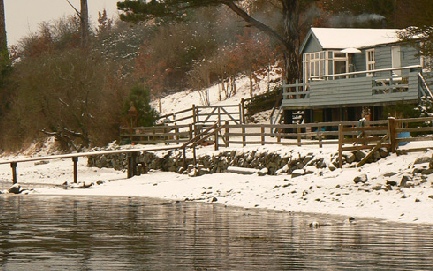
Provençal, it certainly wasn’t. The sky was full of snow, though it wasn’t actually snowing, and a dusting of frost still covered the little mounds of seaweed on the foreshore. The island shivered beneath a blanket of pure white that had the characteristic gleam of a crust on the edge of a thaw. The outboard seemed unusually quiet. We puttered along looking for somewhere to land, and Lynn pointed towards a row of wooden posts, the remains of a stock fence which jutted into the sound from a tree-covered headland. Under the trees, right by the water’s edge, there was an inviting-looking carpet of beech leaves and pine needles – and no snow; so I put the boat in and asked the girls to move aft so that when I hit the cut-off switch and lifted the motor clear of the water, we would be able to beach on a forgiving surface of icy seaweed and, with luck, step ashore without getting our feet wet.
I’m aware as I write this that anyone who read The Blue Cabin, with its scattering of landlubbers-at-sea incidents, might be saying to themselves, ‘Here we go’ or, in the immortal words of baseball legend Peter ‘Yogi’ Berra, ‘It’s like déjà vu, all over again’; but I can say that what happened next had nothing to do with my ability, or otherwise, to tie a sound knot. The girls did manage to step ashore with Rabbie and the picnic, and indeed I managed to follow them; but when I turned to push the boat back into the water, thanks to the dressing of frost on the seaweed it slid backwards a great deal faster than I had expected and the bow rope slipped between my gloved, and rather cold, fingers. For an instant I stood there contemplating the options. We were almost directly across from my uncle’s house on the mainland – just a quarter of a mile – and I had a mobile phone in my pocket. One call would bring him to the rescue. But my uncle Dennis is the real-life version of the persona that I try to project myself sometimes when I’m in charge of the boat and we have a nervous guest on board – that’s to say, the old sea dog who knows everything and always gets you home safe – and I wasn’t sure, what with the dinghy drifting off down the lough and the three of us standing helplessly on the island foreshore within hailing distance of the mainland, that I wanted to hear his comments when he arrived on his rescue mission.
No, it would have to be a bracing winter swim. No time to discard layers – the dinghy was already in deep water and moving gently northwards on the incoming tide. I dropped the phone at my feet and waded in after the dinghy. By the time the water was up to my waist I felt two distinct and equally disconcerting sensations. The first, obviously, was the cold water, which quickly found its way down the inside of my boots and up the inside of my oilskin trousers; but something else, harder to explain, was happening at the same time. I found I was unable to keep my feet, and it wasn’t because I was slipping, or tripping: I can best compare the feeling to one of those dreams where immediate escape is called for, and your legs won’t work. I found myself upended like a cork and spread-eagled on the surface of the water, face down, thrashing my arms and legs in a rather disorganised breaststroke and edging forwards, albeit at nothing like the speed I would expect given the effort I was expending.
For an explanation, I have to rewind five years. It is Christmas morning and the whole family is gathered in my brother’s kitchen. David has always come up with interesting Christmas presents and this time it was a two-part set of oilskins which doubled as a survival suit. The entire thing – body, legs, arms, even the hood – was lined with a highly buoyant neoprene-like material which was guaranteed to keep you afloat should you fall overboard. It had reflective tabs, a whistle for attracting attention and sundry useful-looking straps and buckles for which I would one day find a use (an ongoing project). Of course, I tried it on there and then, an operation which took some time, and I stood there next to the Aga, feeling like Dustin Hoffman in that scene from The Graduate where he tries out his father’s graduation present – a diving suit complete with breathing mask and oxygen, in which he can barely walk. I was twice my normal size, but I must admit I felt extremely cosy, pleasantly insulated from the outside world, and supremely, unexpectedly safe. This was a suit I could survive in for months if necessary. In the years since, no matter what the conditions outside the cabin, be it lashing rain or sub-zero temperatures, I have often managed to maintain my own climate-controlled micro-environment while rowing the punt out, starting the outboard, loading the dinghy and crossing the sound; so that by the time I have started the car, turned on the heater, eased myself behind the steering wheel and wriggled out of my cocoon, I have only really been aware of conditions by virtue of having seen them.
Well, I was wearing my survival suit the day we went for our picnic; but critically, only the bottom half. On a big white panel sewn into the lining of the jacket, there is a warning notice which says: This is not a life jacket. It is a buoyancy aid only and will not self-right an unconscious person. That may be so, but if just the trousers are worn it turns out to be quite capable of up-ending a conscious one. The harder I struggled to ‘swim’ after the boat, the more determined was my survival suit that whatever happened to the rest of me, my legs would survive, so that most of my energy was going into keeping my top half on the surface. . .”